
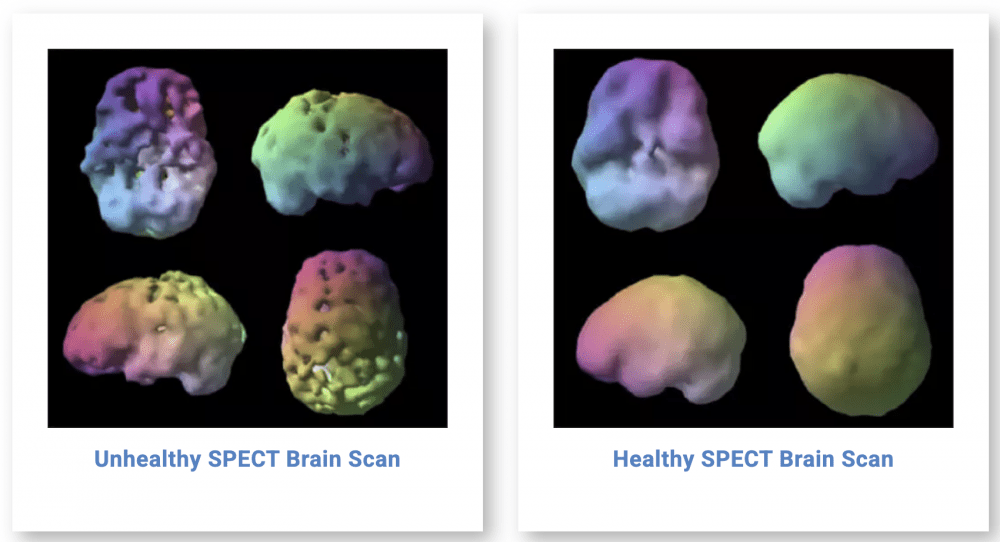
SPECT stands for Single-Photon Emission Computed Tomography. It is a type of nuclear medicine imaging test that can be used to evaluate many different parts of the body, including the brain. Nuclear imaging tests use tracers to show differences in activity in various parts of the body or a particular organ. Other nuclear tests include Bone Scans, PET Scans, Nuclear Heart Stress Tests.
A Brain SPECT scan can be used to help determine parts of the brain that are either working appropriately, underworking, or overworking. Brain work activity is based on the amount of tracer uptake in certain parts of the brain during rest and during stress or concentration. The information from the SPECT scan combined with clinical history can help to diagnose or confirm specific brain disorders. These could include traumatic brain disorders (TBI), stroke, dementia, long covid, and various mental health disorders to include anxiety, depression, OCD, ADD/ADHD, and others.
Many mental health cases can be diagnosed by history and physical examination and respond appropriately to typical treatments and therapies. However, more complex cases may be difficult to diagnose, may be misdiagnosed, and may not respond to usual therapies. These treatment resistant cases can be better assessed with additional data from a Brain SPECT Scan.
At Lone Star Infusion Ketamine clinic, we take a multidisciplinary approach to your care. Some patients come to LSI with a team already in place that may include a psychiatrist, therapist, life coach, and others. Many patients request help from Lone Star Infusion because their condition has been difficult to diagnose and/or treatment resistant. In some cases, a Brain SPECT Scan may help to better focus our multidisciplinary approach and therapy.
Call or email Lone Star Infusion to discuss you case, determine if SPECT Scan is right for you.
Frequently Asked Questions about SPECT Scans
1. What is SPECT Scan?
SPECT stands for Single-Photon Emission Computed Tomography. It is a type of nuclear medicine imaging test that can be used to evaluate many different parts of the body, including the brain. Nuclear imaging tests use tracers to show differences in activity in various parts of the body or a particular organ. Other nuclear tests include Bone Scans, PET Scans, Nuclear Heart Stress Tests.
2. What is the purpose of a Brain SPECT Scan? Is it for diagnostic purposes only, or can it actually “help” me?
A Brain SPECT scan can be used to help determine parts of the brain that are either working appropriately, underworking, or overworking. Brain work activity is based on the amount of tracer uptake in certain parts of the brain during rest and during stress or concentration. The information from the SPECT scan combined with clinical history can help to diagnose or confirm specific brain disorders. These could include traumatic brain disorders (TBI), stroke, dementia, long covid, and various mental health disorders to include anxiety, depression, OCD, ADD/ADHD, and others.
3. Is a Brain SPECT Scan needed to diagnose mental health conditions?
Many mental health cases can be diagnosed by history and physical examination and respond appropriately to typical treatments and therapies. However, more complex cases may be difficult to diagnose, may be misdiagnosed, and may not respond to usual therapies. These treatment resistant cases can be better assessed with additional data from a Brain SPECT Scan.
4. Is Brain SPECT Scan covered by Insurance?
Insurance plans vary greatly in what they cover and under what conditions they will cover. There can be variability even with different plans within the same insurance company. While Brain SPECT Scans may be covered for “organic” concerns, such as brain cancer; SPECT is often not covered for Mental Health conditions, such as ADHD, anxiety, and depression.
As with all of our ketamine infusion patients, we can provide a summary of billed services that can be submitted to your insurance company for consideration of payment.
5. Is Brain SPECT Scan for diagnostic purposes only, or can it actually help me?
Diagnostic tests are meant to help a medical expert support or confirm a diagnosis; or to indicate that a diagnosis is less likely or not present. A Brain SPECT scan can be used to help determine parts of the brain that are working appropriately, underworking, or overworking. Brain work activity is based on the amount of tracer uptake in certain parts of the brain during rest and during stress or concentration. The information from the SPECT scan coupled with clinical history can help to diagnose or confirm specific brain disorders. These could include traumatic brain disorders (TBI), stroke, dementia, long covid, and various mental health disorders to include anxiety, depression, OCD, ADD/ADHD, and others. The additional data from Brain SPECT can be particularly helpful in situations where the diagnosis is not obvious and when typical treatments are not working.
6. Do I need a Brain SPECT Scan with my Ketamine Infusion?
At Lone Star Infusion Ketamine clinic, we take a multidisciplinary approach to your care. Some patients come to LSI with a team already in place that may include a psychiatrist, therapist, life coach, and others. Many patients request help from Lone Star Infusion because their condition has been difficult to diagnose and/or treatment resistant. In some cases, a Brain SPECT Scan may help to better focus our multidisciplinary approach and therapy.
7. Is having a SPECT Scan very involved? What if I am claustrophobic?
Brain SPECT Scans typically take about 20 minutes to complete a scan. There is more preparation time, including IV placement and injection of the tracer. For the concentration scans, a concentration test is performed which the tracer is injected. There is then a waiting period to allow the tracer to taken up in the active parts of the brain before the Brain SPECT Scan is performed. The entire process may take 2-3 hours. See the brief video that outlines and illustrates the process.
Contact Lone Star Infusion to discuss you case, determine if SPECT Scan is right for you.